Nature-Based Learning: Bringing Outdoor Classrooms to Missouri Child Care Programs
A playground does not have to be limited to running, climbing, and burning off energy. A patch of grass can become a place to look for insects. A garden can become a lesson in growth and change. A collection of leaves, rocks, sticks, and pinecones can give children materials to sort, compare, build with, and investigate.
This is the idea behind nature-based learning. Instead of treating outdoor time as a break from learning, child-care programs can use natural spaces and materials to give children opportunities to explore, ask questions, solve problems, and practice skills through direct experience.
It can begin with looking at the outdoor environment differently and finding ways to make what is already there part of children’s learning.
What Is Nature-Based Learning?
Nature-based learning uses outdoor environments, natural materials, and children’s curiosity as part of the learning experience. The activities may be planned by an educator, started by a child, or develop naturally from something children notice outside.
A child who finds a caterpillar may begin asking questions about where it came from. A group sorting rocks might start comparing size, color, and texture. Children building with sticks may discover that some structures are stronger than others.
This approach also aligns with Missouri’s Early Learning Standards, which include science, physical development, social-emotional development, mathematics, language and literacy.
Nature-based learning can support several areas addressed in Missouri’s Early Learning Standards, including science, mathematics, language and literacy, physical development, social-emotional development, and approaches to learning.
Why Outdoor Classrooms Work for Young Children
Physical Development
Outdoor spaces naturally encourage children to move. Running, jumping, balancing, climbing, carrying, digging, and throwing all give children opportunities to develop large-muscle coordination.
Children can also strengthen fine-motor skills outdoors by picking up small natural objects, using gardening tools, manipulating sand or soil, drawing with sticks, or arranging materials.
Problem-Solving and Early Science
Nature is full of things children cannot always predict. These moments give them opportunities to make observations, ask questions, make predictions, and test their ideas.
Language and Communication
Instead of asking a child to memorize new vocabulary, an educator can introduce words as the child observes a rough piece of bark, a tiny insect, a cloudy sky, or a flowering plant.
Social-Emotional Development
Children may have to share tools, negotiate how to build something, wait for a turn, or work with others toward a shared goal.
Unstructured play is especially useful because children have opportunities to make decisions, follow their own ideas, and work through small conflicts rather than having every part of the activity directed by an adult.
What Can an Outdoor Classroom Look Like in a Missouri Child-Care Program?
A Growing and Gardening Area
Even a small garden or group of planters can become a regular source of learning.
Children can:
- Plant seeds
- Water plants
- Observe growth
- Compare leaves
- Count flowers or vegetables
- Notice changes between seasons
A Nature Investigation Area
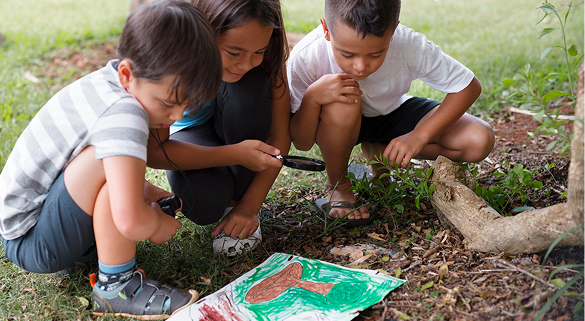
A small area with magnifying glasses, containers for observation, clipboards, or simple collection baskets can encourage children to look more closely at what they find.
They might examine a leaf, observe an insect, compare rocks, or look for evidence of animals.
A Movement Area
Outdoor classrooms also need room for children to move.
An open space can be used for running games, obstacle courses, balancing activities, dancing, or simple movement challenges. The arrangement can change according to children’s interests and developmental needs.
A Quiet Observation Space
Not every child needs to be moving all the time. A shaded bench, small reading area, or designated observation spot can give children somewhere to look, listen, talk, or take a short break from active play.
Nature-Based Activities for Different Ages
Outdoor learning can be adapted to children’s developmental stages rather than using the same activity for every group.
Infants and Toddlers
For very young children, nature-based learning may begin with sensory experiences.
Children can:
- Feel grass, leaves, or tree bark
- Listen to birds and other outdoor sounds
- Watch leaves move in the wind
- Explore sand, water, or soil with close adult supervision
- Notice sunlight, shade, rain, or snow
Preschoolers
Preschool-age children can begin taking a more active role in outdoor investigations.
They can:
- Sort natural objects
- Plant and water seeds
- Look for insects
- Collect and compare leaves
- Build with sticks or other loose materials
- Observe weather changes
- Create nature-inspired art
Pre-K Children
Older preschoolers can take their observations further.
They might keep simple weather records, compare plant growth, map an outdoor area, make predictions, design structures with natural materials, or discuss why a plant or insect might behave in a certain way.
Conclusion
An outdoor classroom does not need walls, desks, or a long list of expensive materials. It needs a space where children can notice something, wonder about it, and have time to find out more.
A child-care provider can turn a planter into a science lesson or give children a few sticks and enough time to decide what they can build. The learning comes from what children do with those opportunities.
For educators looking to strengthen these experiences, Child Care Aware of Missouri offers professional development and resources to support Missouri child care programs and early childhood professionals.